
Most Greater Atlanta homeowners think about their gutters twice a year: when leaves are falling and when something goes visibly wrong. Spring is the season that exposes everything those gutters collected over winter, and a clogged or damaged system heading into Georgia’s heaviest rainfall months is one of the most reliable sources of preventable water damage a property owner will face. This guide walks you through why spring gutter cleaning matters, what to look for, and how to do it right.
Why Spring Is the Most Important Time to Clean Your Gutters
Winter in Greater Atlanta is mild compared to most of the country. But mild does not mean inactive. Between November and March, gutters accumulate a steady load of leaves, seed pods, pine needles from Georgia’s dense tree canopy, and debris carried in by wind events. By the time spring arrives, that material has often compacted into a dense, moisture-retaining mass sitting at the base of the gutter channel.
That matters because spring is when Greater Atlanta’s rainfall intensity peaks. The region averages over 50 inches of rain annually, with April and May consistently ranking among the wettest months. A gutter system that is partially or fully blocked heading into that period cannot move water away from the roofline and foundation at the rate the weather demands. The overflow that follows is not a minor inconvenience. It is the starting point for fascia rot, soffit damage, foundation erosion, and in some cases interior water intrusion that goes undetected until significant structural damage has occurred.
Cleaning gutters in late March or early April puts your drainage system in the best possible position before the bulk of spring rainfall arrives. That timing is the single most impactful gutter maintenance decision a Greater Atlanta homeowner can make each year.
What a Proper Spring Gutter Cleaning Actually Covers
Removing visible debris from the gutter channel is the starting point, not the complete job. A thorough spring gutter cleaning covers several components that each affect how the system performs under heavy rainfall.
Start with the gutter channels themselves. Remove all accumulated debris by hand or with a gutter scoop, working from the closed end of each run toward the downspout opening. Do not push debris toward the downspout, as this compacts material into the one area where blockage causes the most immediate drainage failure.
Next, flush each section with a garden hose from the high end toward the downspout. This step confirms that water flows at the correct pitch without pooling in any section, and it identifies any seam leaks or cracks that dry cleaning alone would not reveal. Pay attention to the flow rate at the downspout outlet. A significantly reduced flow despite a clear channel usually indicates a blockage further down the downspout run.
Clear each downspout completely. A plumber’s snake or high-pressure hose attachment removes compacted debris that flushing alone cannot dislodge. In Greater Atlanta homes surrounded by mature trees, downspout blockages from accumulated organic material are one of the most common causes of gutter overflow, and they are invisible from the ground until water backs up at the roofline.
Once the system is clear and flushed, inspect the following:
- Gutter pitch and alignment. Each section should slope visibly toward the downspout. A level or back-pitched section holds standing water that accelerates corrosion and attracts mosquitoes during Georgia’s warm months.
- Seam and joint integrity. Any separation between gutter sections allows water to drip directly onto the fascia board below. Reseal open seams with gutter sealant before the spring rain season begins.
- Attachment hardware. Gutter spikes and hangers loosen over time, particularly after winter freeze-thaw cycling and debris loading. Sagging sections that have pulled away from the fascia will overflow regardless of how clean the channel is.
- Downspout extensions and splash blocks. Confirm that water exiting each downspout is directed at least four to six feet away from the foundation. Extensions that are missing or displaced concentrate water at the foundation perimeter, where it contributes to settling, basement moisture, and in some cases structural movement over time.
The Water Damage That Starts With a Clogged Gutter
Understanding what a neglected gutter system produces helps make the case for keeping the maintenance calendar. The connection between clogged gutters and water damage is direct, and it develops faster than most homeowners expect.
When gutters overflow at the roofline, water runs behind the gutter channel and makes sustained contact with the fascia board and soffit below it. Wood fascia that is repeatedly saturated softens, rots, and eventually loses its structural role as the attachment point for the gutter system itself. That deterioration is rarely visible until a section of gutter pulls away from the roofline entirely, at which point the fascia replacement adds significant cost to what would have been a simple cleaning and seam repair.
Water that overflows at foundation corners concentrates at the soil line where hydrostatic pressure is highest. In Greater Atlanta’s clay-heavy soils, which expand when saturated and contract when dry, repeated moisture cycles from overflowing gutters accelerate foundation movement that standard maintenance does not address. Basement and crawl space moisture problems in Atlanta-area homes are frequently traced back to long-term drainage failures at the gutter and downspout level rather than rising groundwater.
The interior water damage connection is equally important. Overflow at the roofline saturates the fascia and can work its way under the lowest course of shingles, introducing moisture into the roof assembly that damages decking and insulation before any interior staining appears. By the time a ceiling stain shows up in a bedroom or hallway, the moisture pathway has typically been present for longer than the stain suggests.
When to Call a Professional Instead of DIYing the Job
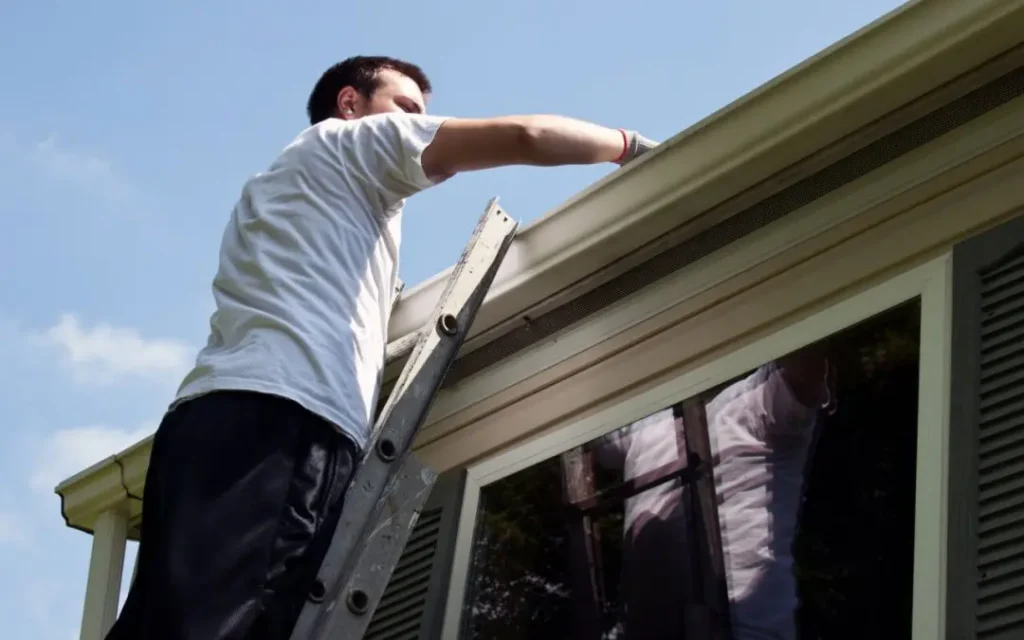
Gutter cleaning is a manageable DIY task for single-story homes with straightforward rooflines and safe ladder access. Several situations make professional service the smarter choice.
Multi-story homes and steeply pitched rooflines make gutter access genuinely dangerous without proper equipment and safety training. A fall from a ladder is a serious injury risk, and it is not worth the cost savings of a DIY cleaning on a two-story colonial or a home with a steep gable roofline above the gutter run.
Gutters that show structural damage, including sections pulled away from the fascia, significant bending from hail or storm impact, or visible rust and cracking in metal systems, need professional assessment before cleaning. Cleaning a damaged gutter without addressing the underlying structural issue produces a clean but still-failing system.
If your gutters have not been cleaned or inspected in more than a year, a professional service that combines cleaning with a full condition assessment gives you an accurate picture of what your system needs heading into spring. A technician working from a ladder at roofline level can identify fascia deterioration, soffit damage, and roofline conditions that a ground-level inspection cannot capture.
Spring is also the season to assess whether gutter guards are worth adding to your system. Greater Atlanta’s tree coverage makes gutters maintenance-intensive, and while no guard system is maintenance-free, the right product for your specific debris profile can significantly reduce the frequency and depth of cleaning required through the remainder of the year.

The Spring Gutter Checklist for Greater Atlanta Homeowners
Before you close out your spring gutter maintenance, run through this quick checklist to confirm the system is fully ready for the season ahead:
- Gutter channels cleared of all debris from end to downspout
- Each section flushed with water and confirmed draining at correct pitch
- All downspouts cleared and flowing freely at the outlet
- Seams and joints resealed where separation was found
- Attachment hardware tightened or replaced where sagging was present
- Downspout extensions confirmed directing water four to six feet from foundation
- Any structural damage, rot, or significant corrosion flagged for professional assessment
That checklist takes less than an hour on a straightforward single-story home and significantly less time than dealing with the water damage a neglected gutter system produces when spring storms arrive in full force.
Spring Is the Right Time to Get This Done
The team at Alpine Roofing & Restoration is ready to help. Contact us today to schedule a professional gutter cleaning and inspection at your Greater Atlanta, GA property and make sure your drainage system is fully ready before spring’s heaviest rainfall season begins.